For more than 130 years, The Oval Bandstand & Lawns has occupied a distinctive place in the history of Cliftonville and Margate. Overlooking the sea from Eastern Esplanade, it has witnessed the rise of the great British seaside holiday, welcomed royal visitors, entertained generations with music and comedy, hosted professional wrestling and even became home to an elaborate model village. Its lawns have been filled with thousands of deckchairs, grazed by donkeys and enjoyed by generations of residents and holidaymakers.
The story of The Oval, however, is not simply one of nostalgia. Like Cliftonville itself, the site has experienced periods of enormous popularity and periods of considerable decline. By the years leading up to 2021, ageing infrastructure, underinvestment and deterioration had left a historic community asset requiring substantial work. Antisocial behaviour, street drinking, discarded bottles and smashed glass had also become recurring problems, contributing to an environment far removed from The Oval’s heyday.
A major turning point came when Thanet District Council placed the site into a competitive Community Asset Transfer process ( Three organisation applied to the council to take on The Oval). GRASS Cliftonville CIC successfully bid to take responsibility for its future and, on 8 July 2021, acquired the freehold of The Oval Bandstand & Lawns and its associated buildings.
The years since have seen one of the most significant periods of change in The Oval’s history. The site has been progressively restored and improved, new investment has been secured, community activity has returned and a growing programme of entertainment has once again filled the amphitheatre. In 2025, just four years after the transfer, The Oval received its first Green Flag Community Award and retained the award in 2026.
To understand the significance of that transformation, it is necessary to return to the beginning.
From School Playing Fields to a Victorian Seaside Attraction
Before The Oval became a place of public entertainment, the land belonged to Charles Schimmellmann, headmaster of Albion House preparatory school in Sweyn Road. For around 20 years the grounds were used by pupils for cricket practice and matches. Following Schimmellmann’s death in 1890, his estate was sold and the land at Queen’s Gardens was acquired by Jacob Leach Lewis.
That same year, permission was given for a temporary bandstand to be erected and the Red Viennese Band performed during the summer months. It was the beginning of an association between this stretch of Cliftonville coastline and live entertainment that would endure for well over a century.
The decisive transformation came in 1897. The land was excavated to create the distinctive amphitheatre that remains at the heart of The Oval today, with an ornate wrought-iron bandstand erected at its centre. Around 2,000 deckchairs could be arranged on the surrounding terraces, creating an impressive outdoor entertainment venue overlooking the sea.
Bandstands occupied an important place in Victorian and Edwardian seaside culture. Long before radio, television and recorded entertainment became part of everyday life, live music was one of the great attractions of the seaside resort and paid entry was part of the format in the fenced amphitheatre . Cliftonville was expanding rapidly and developing a reputation as a fashionable destination, and The Oval became part of the entertainment infrastructure created to serve the growing number of visitors.
Even the maintenance of the lawns reflected the character of the period. Local donkey keeper Benjamin Baker grazed his animals on the grass, helping to keep it short while his donkeys formed part of the wider seaside scene. For the following decades, The Oval established itself as one of the focal points of entertainment in Cliftonville.
The area’s growing importance was reflected in further investment during the early twentieth century. In 1926, improvements were made around The Oval as part of wider development of the seafront, and the Prince of Wales – the future King Edward VIII and later Duke of Windsor – visited Cliftonville for the opening of the Prince’s Walk promenade. It was an era when Margate and Cliftonville were flourishing resorts and substantial effort was being made to create attractive public spaces and entertainment for visitors.
Music, Comedy, Wrestling and Margate in Miniature
Music remained central to The Oval for much of the twentieth century. Numerous musicians, vocalists and comedians appeared at the bandstand, including performers who would later become familiar to audiences far beyond Thanet. Pianist Alex Inman appeared in 1959, while trombonist Jackie Wright performed in 1960 before later becoming known to millions through his appearances on The Benny Hill Show. Vocalists Carole Hayes and Dennis Stewart were also among those who performed during the 1950s.
For generations of Cliftonville residents and holidaymakers, summer entertainment at The Oval became part of the rhythm of seaside life. Among the performers most affectionately remembered locally is organist Tony Savage, whose appearances became closely associated with the bandstand. Decades later, GRASS would acknowledge that connection by showing archive footage of Tony performing at The Oval before one of its outdoor cinema screenings, bringing together two very different eras of entertainment at the same amphitheatre.
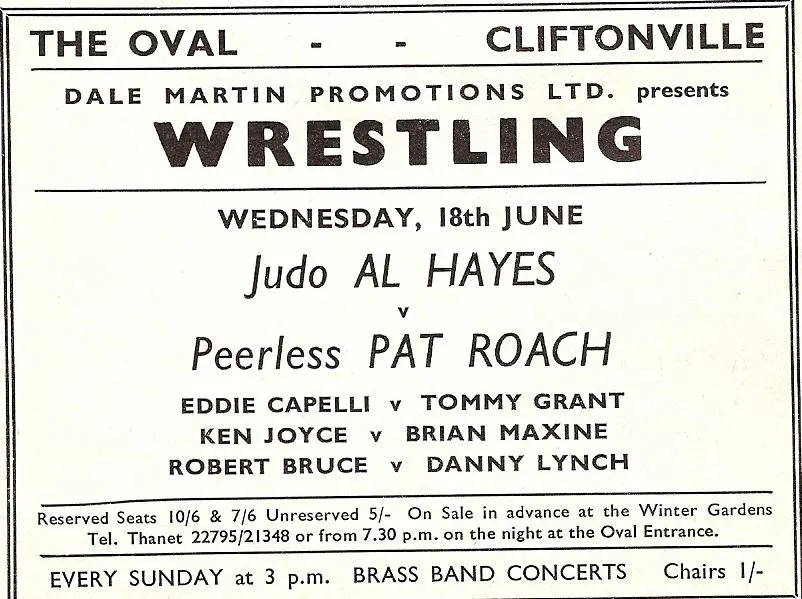
The programme was never confined to music. During the late 1960s and 1970s, The Oval became a venue for professional wrestling at a time when the sport attracted enormous television audiences in Britain. Wrestlers associated with appearances at The Oval included Pat Roach, who would later become well known as both a wrestler and actor, and one of the most recognisable figures in British wrestling, Big Daddy. More than half a century later, professional wrestling would return to the same amphitheatre as part of The Oval’s revived programme.
The 1970s also brought one of the site’s most unusual attractions: a model village. Work on the models began in 1968, with development on site beginning around 1970. Built at a scale of one inch to one foot, the attraction included miniature versions of local buildings, including a replica of Margate’s Dreamland.
More than 5,000 plants were reportedly incorporated into the landscaping, together with a miniature railway and illuminations that could be enjoyed as dusk fell. The Duke and Duchess of Bedford officially opened the attraction in April 1971, while ambitious proposals for further development included a fishing village with boats and ferries, a quarry, watermill, school, abbey ruins, shops, houses and a fire station. The model village occupied land close to where Queen’s Court stands today and remains one of the more extraordinary chapters in The Oval’s history.
For much of the twentieth century, therefore, The Oval continually adapted to changing tastes. Music, comedy, wrestling and visitor attractions may have been very different forms of entertainment, but they shared a common purpose: bringing people together at one of Cliftonville’s most distinctive seaside locations.
Decline, Disrepair and an Uncertain Future
The second half of the twentieth century brought profound changes to Britain’s traditional seaside resorts. Cheap overseas travel transformed holiday habits, while television and changing patterns of entertainment reduced the role once played by bandstands and other traditional seaside attractions. The enormous audiences, rows of deckchairs and busy summer entertainment programmes that had characterised places such as Cliftonville gradually diminished.
The Oval survived, but the investment required to maintain a large and exposed coastal site did not always keep pace with its needs. Over time, buildings and infrastructure aged, facilities became increasingly dated and areas of the site required substantial improvement. The amphitheatre and lawns remained, as did the remarkable setting overlooking the sea, but the condition of the wider site increasingly reflected years of underinvestment.
By the years immediately preceding 2021, the problems were increasingly visible. Buildings and infrastructure required considerable attention, while the environment around the site had also deteriorated. Antisocial behaviour and street drinking had become recurring challenges. Groups gathering to drink on and around The Oval were a familiar sight, with discarded bottles, cans and other rubbish regularly left behind. Smashed glass created a particular concern across lawns and areas that should have provided a safe and welcoming environment for families, children and other visitors. Vandalism and damage added to the difficulties of maintaining the site.
For a place with such a significant history, it was a troubling position. The Oval remained one of Cliftonville’s most recognisable landmarks and occupied more than four acres of valuable coastal green space, yet its physical condition and the problems surrounding its use increasingly threatened its future. What was required was not simply another programme of occasional events, but long-term investment, active management and an organisation prepared to take responsibility for the site as a whole.
The Loss of the Original Bandstand
Sadly, the bandstand standing at The Oval today is not the original Victorian structure. The ornate original was removed and a decision was subsequently taken to replace it with a modern interpretation. While the replacement was intended to reflect the site’s historic use, it was not an exact reconstruction.
Viewed through the principles of heritage conservation today, a very different approach would almost certainly be considered. Greater emphasis would be placed on retaining and restoring as much of the original structure and historic fabric as possible, with any necessary modern intervention designed much more sympathetically around the bandstand character, proportions and setting of the original amphitheatre. Where bandstand replacement proved unavoidable, an accurate reconstruction based on surviving photographs, plans and historical evidence would be more likely to form part of the discussion.
The removal of the Victorian bandstand therefore represented the loss of one of The Oval’s most important original architectural features, while its replacement further changed the historic character of the amphitheatre. The present bandstand has since become part of The Oval’s own history and continues to fulfil its most important purpose as a place for live performance, but the loss of the original remains one of the most regrettable chapters in the site’s architectural story.
The Community Asset Transfer and GRASS Cliftonville CIC
In January 2019, Thanet District Council began a Community Asset Transfer process for The Oval Bandstand & Lawns. Community Asset Transfer provides a mechanism through which publicly owned land and buildings can be transferred to community organisations capable of demonstrating a sustainable plan for their future.
In the case of The Oval, the process was competitive. Organisations were invited to submit proposals setting out how they would manage the site, finance its operation and secure its long-term future. Several groups submitted bids, with GRASS putting forward its own business plan and vision for the regeneration of The Oval.
GRASS already had a long association with Cliftonville and the site. Established in 2003 as a resident-led community organisation and subsequently incorporated as GRASS Cliftonville CIC, it had been involved in community activity at The Oval for many years. Events and initiatives had demonstrated that people would return to the site when there were positive reasons to do so, but taking ownership of more than four acres of land and its associated buildings represented a very different level of responsibility.
Following assessment of the competing proposals, GRASS was selected by Thanet District Council as the successful organisation to take the Community Asset Transfer forward. The process continued through the disruption of the Covid-19 pandemic, involving detailed legal, financial and operational work before the acquisition could finally be completed.
On 8 July 2021, the freehold of The Oval Bandstand & Lawns and its associated buildings formally transferred from Thanet District Council to GRASS Cliftonville CIC.
The significance of the transfer is important. GRASS was not simply appointed to organise events or manage The Oval on behalf of the council. The organisation became the legal freehold owner of the site, taking responsibility for its management, maintenance, finances and future development. After decades in public ownership, The Oval had entered a new era of community ownership.
Winning the competitive asset transfer was an important achievement, but in practical terms it represented the beginning rather than the end of the challenge.
Farmers’ Market
For a number of years, the Cliftonville Farmers’ Market operated at The Oval. Following GRASS Cliftonville CIC becoming the freeholder of The Oval in 2021, it sought to place the market’s continued use of the grounds on a proper formal footing.
GRASS offered the market the opportunity to continue operating at The Oval under a formal licence. As part of that process, the organisers were asked to provide the organisational, insurance, risk-management and financial information required to complete the necessary due diligence. Despite repeated requests, the required information was not provided in full. This included the organisation’s constitution and details of those responsible for its management or committee.
GRASS continued to seek the outstanding information in an effort to complete the arrangements. With the necessary information remaining outstanding, the licence could not be finalised and the matter subsequently resulted in formal correspondence through solicitors.
GRASS’s position throughout was that the market could have continue at The Oval, provided the requirements necessary to put a formal licence in place were completed. Unfortunately, that process was never completed in full.
Rebuilding The Oval from 2021
The site inherited by GRASS required substantial work. Urgent infrastructure improvements had already been identified around the time of the transfer, including electrical works, CCTV and security measures, repairs and repainting to protect the bandstand from further deterioration, and improvements to buildings and facilities.
There was also a less tangible but equally important challenge: The Oval needed to feel cared for again. Tackling litter, broken glass, vandalism and antisocial behaviour became part of the everyday responsibility of managing the site. Improved security and more active management were important, but GRASS also recognised that the long-term answer was to bring legitimate activity back into the space.
That principle has shaped much of the regeneration since 2021. Rather than treating physical restoration and community programming as separate objectives, they have developed alongside one another. As infrastructure has improved, the programme has expanded; as more people have returned to The Oval, the case for further investment has strengthened.
The physical work has been extensive and progressive with no support or help from Thanet District Council. The bandstand has been repaired and repainted, electrical infrastructure upgraded and CCTV and security measures introduced. Accessibility has been improved through ramps, handrails and other works, while buildings and facilities have been progressively refurbished and brought back into useful condition. Landscaping and planting have been developed, and new facilities have been introduced as funding and resources have allowed.
Environmental sustainability has also become an important part of the site’s future. Major energy-efficiency works have included insulation, LED lighting, replacement doors and windows, solar panels and battery storage, reducing energy consumption and helping to create a more sustainable operational model for the site.
In 2024, planning permission was granted for a further substantial phase of development, supporting improvements to the café and events facilities, accessible routes, community spaces and the wider site, together with plans for a Wellness Garden and Outdoor Gym. The programme reflects the reality that regenerating a historic four-acre coastal site cannot be achieved through a single grant or building project. The work has instead progressed incrementally, with each improvement contributing to the longer-term vision.
Bringing People Back to The Oval
The physical regeneration of The Oval has been accompanied by an equally significant revival of its role as a place of entertainment and community activity.
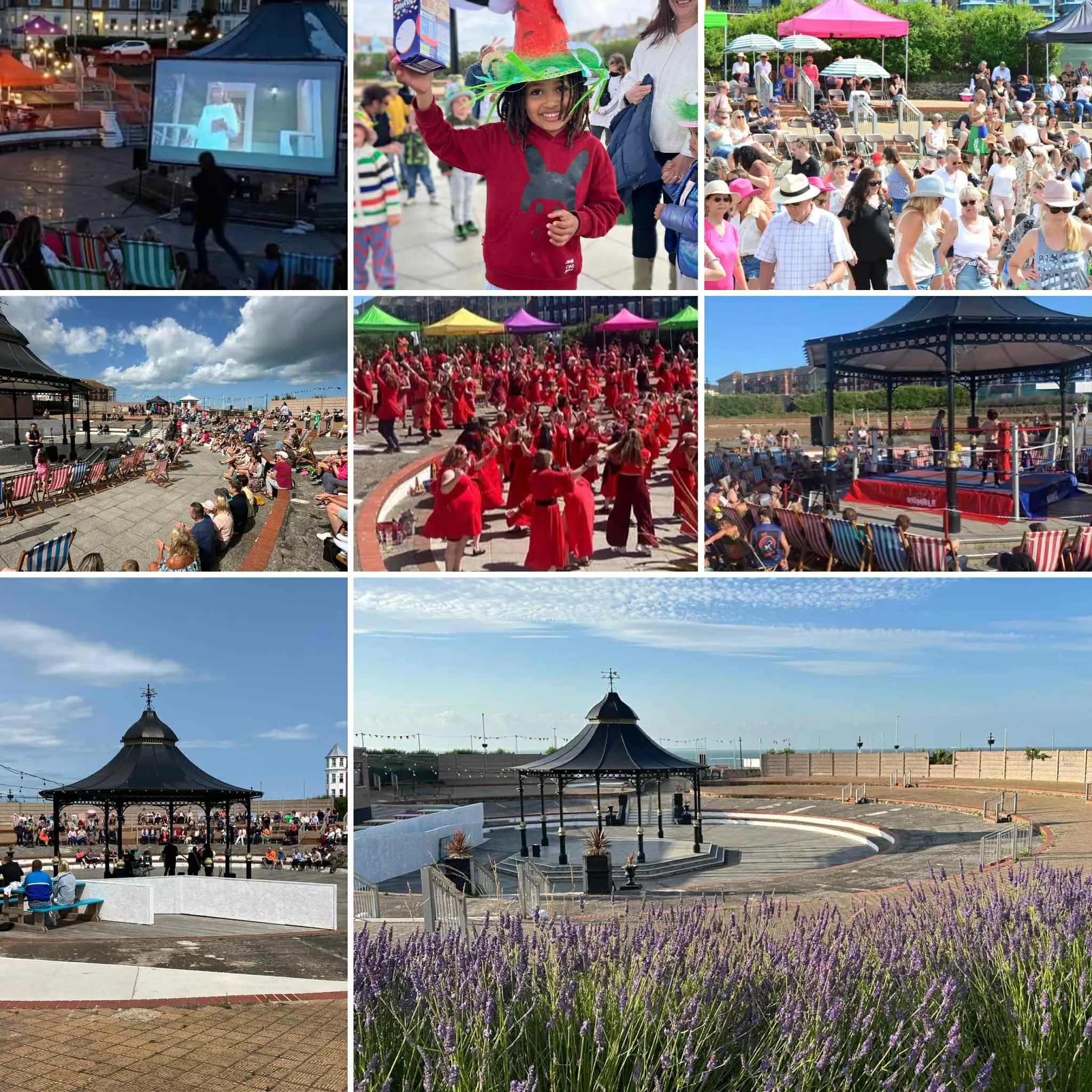
Live music has once again become a regular feature of summer at the bandstand. Summer Sundays have brought performers and audiences back to the amphitheatre, while professional theatre companies have used its unusual natural setting for open-air productions. Outdoor cinema has brought audiences to the site after dark, and professional wrestling has returned decades after its earlier appearances at The Oval.
The lawns have hosted classic car and motorcycle shows, family activities, community celebrations and special events, while fitness and wellbeing programmes have expanded the ways in which local residents use the site. The Oval can now welcome hundreds of people for a major entertainment event while also providing a setting for smaller community, volunteering and wellbeing activities.
New traditions have also begun to establish themselves. The Most Wuthering Heights Day Ever, for example, has brought hundreds of people together at The Oval while raising thousands of pounds for local causes. Alongside music, theatre, cinema and family events, these newer activities are creating their own place in the site’s history.
This revival is significant because organised activity is itself part of successful regeneration. A neglected space with little legitimate use can quickly become associated with further neglect. A well-managed site filled with families, performers, volunteers and audiences creates a completely different environment. Bringing people back to The Oval has therefore been as important as repairing buildings or improving infrastructure.
There is also an important continuity with the past. The entertainment may have changed considerably since Victorian audiences occupied thousands of deckchairs around the bandstand, but the fundamental purpose of The Oval remains remarkably familiar: a place where people gather together beside the sea.
From Disrepair to Green Flag
One of the most important milestones in The Oval’s modern history came in 2025, just four years after GRASS acquired the freehold, when The Oval Bandstand & Lawns received its first Green Flag Community Award.
The Green Flag Award is the internationally recognised quality standard for parks and green spaces. For GRASS, achieving the award represented much more than receiving a flag. It provided independent recognition of the work undertaken to manage the site, improve its environment, maintain its green space, provide community benefit and plan for its sustainable future.
The contrast with the position inherited in 2021 was considerable. A site requiring urgent infrastructure works, improvements to security and sustained physical regeneration was now being recognised as a quality community-managed green space.
In 2026, The Oval retained its Green Flag Community Award for a second consecutive year, reinforcing the progress made since community ownership began. For a small not-for-profit organisation managing a large historic coastal site, achieving and retaining that standard represents an important endorsement of the direction The Oval has taken.
The Green Flag does not mean that every challenge has disappeared. Maintaining a public-facing coastal site of this scale is a continual responsibility. Buildings require investment, the landscape needs constant attention, antisocial behaviour still has to be managed and significant projects remain to be delivered. Regeneration is an ongoing process rather than a point at which the work can simply be declared complete.
What has changed fundamentally is the trajectory of the site. The Oval is being invested in, actively managed and increasingly used. Where deterioration once threatened its future, there is now a long-term plan for its continued improvement.
Protecting The Oval for the Next Generation
Today, The Oval Bandstand & Lawns extends across more than four acres of Cliftonville’s coastline and performs several roles at once. It is a historic landmark, a community green space, an outdoor performance venue and the home of an expanding programme of community activity.
GRASS Cliftonville CIC operates as a not-for-profit social enterprise, with income generated through the site reinvested into the organisation and the continued operation and development of The Oval. That model is important because protecting the site requires more than restoring its historic features; it also requires creating a financially and operationally sustainable future.
The contrast between 2021 and today is considerable. Infrastructure has been improved, buildings and facilities are progressively being restored, environmental investment has been made and thousands of people have returned for events and activities. Where the future of the site was once uncertain, there is now a clear programme for its continued development.
The Oval’s history has never stood still. It has evolved from school playing fields into a Victorian entertainment ground; from an Edwardian seaside attraction into a venue for musicians, comedians and wrestlers; from the home of a miniature Margate to a place remembered by generations for summer music and Tony Savage at the organ. There were also difficult periods when the site deteriorated and its future became less certain. That part of the history should not be hidden, because it provides essential context for understanding what has happened since.
Community ownership in 2021 marked the beginning of the latest chapter. GRASS successfully competed for the opportunity to take responsibility for The Oval, acquired its freehold from Thanet District Council and began the long process of rebuilding a site that had been allowed to deteriorate.
Much has been achieved, but the work continues. Further improvements to facilities, accessibility, environmental sustainability and community provision are planned as The Oval continues to evolve.
More than 130 years after the first audiences gathered here to listen to music, people are once again filling the amphitheatre on summer afternoons. The surroundings have changed, the entertainment has changed and Cliftonville itself has changed, but The Oval continues to perform the role for which it became famous: bringing people together.
The best way to protect a historic place is not simply to preserve it as a monument to the past. It is to give it a purpose in the present and a sustainable future.
The Oval has been part of Cliftonville’s story for more than a century. GRASS Cliftonville CIC and its small team is committed to ensuring that it remains part of that story for generations to come.